Corporate Relocation to Tokyo: Housing Guide for HR Teams
Managing a Tokyo relocation for an employee? Complete guide for HR and mobility managers: timelines, housing types, costs and what to plan to ensure a smooth arrival.
Relocating an employee to Tokyo involves more complexity than most HR managers anticipate. The Japanese rental market does not operate like Western markets: there is no automated matching system, leases require specific documentation, and the timeline from "we need housing" to "keys in hand" is typically 4-8 weeks under ideal conditions.
Quick answer: Relocating an employee to Tokyo takes 4 to 8 weeks from brief to keys, longer than most HR teams expect. Budget move-in costs of 3 to 5 months' rent for a standard lease, or use furnished and serviced apartments for speed and flexibility. Brief a bilingual property hunter early, and plan temporary housing if the employee arrives before the lease is signed.
This guide is written for HR managers, mobility coordinators, and office managers responsible for getting a team member settled in Tokyo as efficiently as possible.
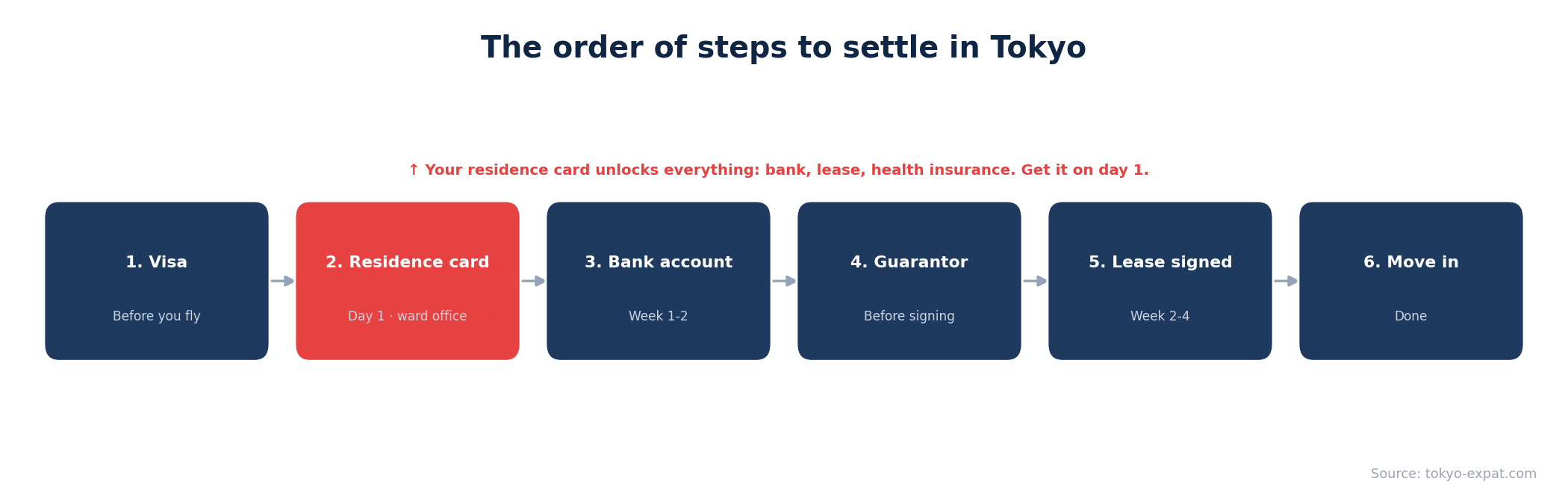
The Standard Tokyo Relocation Timeline
Understanding the timeline is the most important thing you can do before triggering a relocation.
Week 1-2: Pre-arrival preparation
- Confirm employee's visa status and expected arrival date
- Establish the housing budget (rent + entry costs)
- Define the neighborhood priorities (proximity to office, family needs, school requirements)
- Brief a real estate hunter or relocation specialist
Week 2-4: Property search and application
- Property selection based on the brief
- Application submission and landlord review (3-7 business days)
- Guarantor company arranged (required for foreign employees)
Week 4-6: Signing and setup
- Lease signing
- Utility setup (gas, electricity, internet)
- Key handover
If your employee arrives before the lease is signed, budget for temporary accommodation: serviced apartments or hotels in Tokyo run 8,000-15,000 JPY per night for business-appropriate properties.
Housing Types and Their Trade-offs
Standard 2-year lease unfurnished apartment
The lowest monthly rent for a given size, but the highest entry cost (3-5 months upfront) and the least flexibility. Suitable when the employee is staying at least 2 years and the company can absorb entry costs and furnishing.
Furnished monthly mansion (manshu)
20-30% higher monthly rent than unfurnished, but minimal entry cost (1-2 months), no furniture expense, and flexible lease terms from 1 month. Best for probationary periods, short assignments, or when the final assignment duration is uncertain.
Serviced apartment / corporate apartment
Full hotel-style services, utilities included, housekeeping available. The most expensive option per month (150,000-400,000 JPY for a 1LDK) but zero administrative friction. Best for the first 1-3 months while the employee finds a permanent solution.
Get the Japan Relocation Checklist (free PDF)
90+ concrete action items to prepare your move to Japan, across 7 phases. Sent instantly.
What the Company Pays vs. What the Employee Pays
The clearest way to avoid relocation friction is to be explicit about this before the employee arrives.
Typically company-covered:
- Entry costs (security deposit, agency fee, key money): 3-6 months of rent upfront
- Guarantor company fee (0.5-1 month of rent per year)
- Furniture and appliance budget for unfurnished apartments
- Temporary accommodation until lease signing
Typically employee-covered:
- Monthly rent from the agreed housing allowance
- Utilities (electricity, gas, internet): 20,000-35,000 JPY per month
- Local insurance (renters insurance: 15,000-20,000 JPY per year)
The Guarantor Question
This is the aspect that surprises HR managers most. In Japan, most standard rental contracts require a guarantor: a Japanese citizen employed full-time who agrees to cover unpaid rent. Foreign employees almost never have this.
The solution is a guarantee company (hoshougaisha). The fee is typically 0.5-1 month of rent per year. This cost should be explicitly included in your relocation budget.
Some landlords still prefer a personal guarantor. For corporate relocations, some companies provide a corporate guarantee letter instead, which landlords in the expat-friendly segment often accept.
Why Local Expert Knowledge Matters
The Japanese real estate market is highly local. The same apartment can be listed by 3 different agencies at 3 different prices. The best properties are often not on public portals. Negotiating entry costs requires knowing which landlords are open to it.
For a corporate relocation, partnering with a real estate hunter or relocation specialist who knows the Tokyo market shortens the timeline from 6-10 weeks to 2-3 weeks, and reduces the risk of placing the employee in an unsuitable property.
See: How a real estate hunter works in Tokyo and real estate hunter cost and ROI
Checklist Before the Employee Arrives
- Housing budget confirmed (rent + entry costs + temporary accommodation)
- Neighborhood brief established based on office location and family needs
- Real estate hunter or relocation specialist briefed
- Company guarantee letter prepared (if not using a guarantee company)
- Temporary accommodation booked for the first 2-4 weeks
- Furniture budget confirmed if targeting unfurnished apartment
Contact us for a corporate relocation consultation. We work with mobility teams and HR managers handling Tokyo relocations for French and international employees.
For employee health coverage during relocation, SafetyWing Nomad Insurance offers monthly insurance with no commitment, activatable before Japanese national insurance enrolment. (affiliate link)
Read next: Tokyo rent by neighborhood 2026 and how a real estate hunter works in Tokyo.
Frequently Asked Questions
How long does a corporate relocation to Tokyo typically take?+
What is the typical corporate housing budget for Tokyo in 2026?+
Does a company need to provide a guarantor for employee housing in Tokyo?+
Should HR use a full relocation company or a real estate hunter for Tokyo?+
Get the Japan Relocation Checklist (free PDF)
90+ concrete action items to prepare your move to Japan, across 7 phases. Sent instantly.
Need help finding housing in Tokyo?
I help you find the right home, with no Japanese guarantor and no language barrier. Free consultation, no commitment, in English or French.
Book my free consultation