How to Find an Apartment in Tokyo as a Foreigner (2026 Guide)
Guarantors, language barriers, key money: the Tokyo rental market is notoriously difficult for foreigners. Here is exactly how to navigate it.
Tokyo has one of the most closed rental markets in the world for foreigners. No permanent residency, no Japanese guarantor, no local bank account: most agencies will decline your application before you even visit a property.
Quick answer: To rent in Tokyo as a foreigner, start with no-guarantor options (share houses, furnished or monthly mansions) that accept just a passport and visa, or use a bilingual agent plus a guarantor company for a standard lease. Apply remotely before you land, budget 4 to 6 months of upfront costs for a standard lease, and allow 2 to 8 weeks depending on the housing type. If you want to skip the guarantor entirely, our complete guide to furnished apartments in Tokyo breaks down every fast move-in option.
Yet thousands of expats find housing in Tokyo every year. The difference between those who settle in two weeks and those who struggle for three months comes down to method.
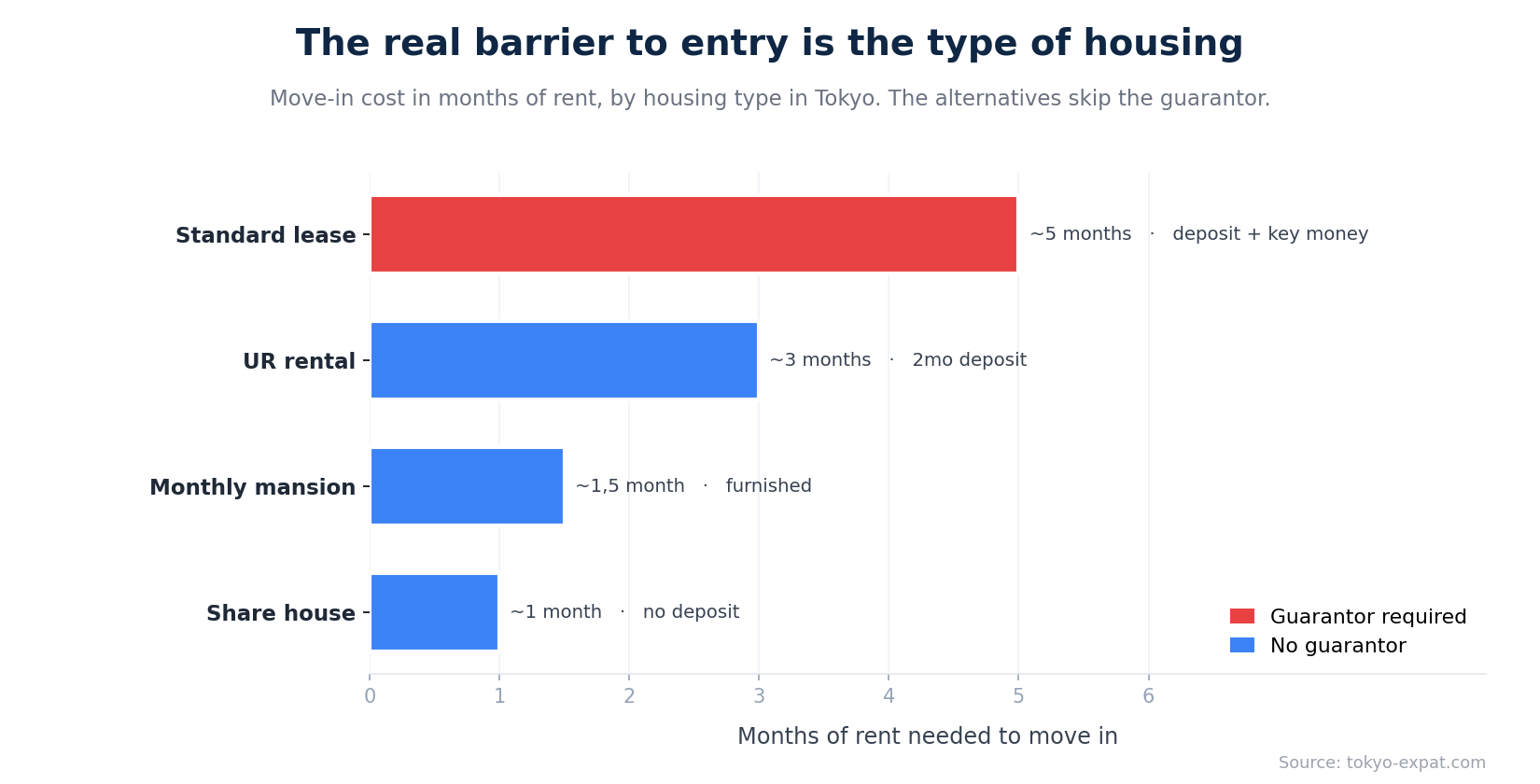
The guarantor problem
Almost all traditional Japanese rental properties require a hoshounin (personal guarantor): a Japanese citizen who agrees to cover your rent if you default. For a foreigner without Japanese family, this is a hard wall.
Three solutions exist:
1. Guarantee companies (hoshougaisha)
These companies replace the human guarantor for an annual premium of 0.5 to 1 month of rent. Most modern properties accept this system. Cost: around 50,000 JPY per year for a 100,000 JPY/month apartment.
2. Furnished rentals with no guarantor required
Some furnished housing operators targeting foreigners offer leases without a guarantor. Eligibility requirements are looser: a valid visa and an employment contract often suffice. This is the fastest route to immediate housing.
3. Corporate housing (shataku)
If your Japanese employer sponsors you, they can lease directly in the company name. The guarantor is the company itself. Very common in large corporations.
The language barrier
Even if you speak fluent English, you will struggle. Most Japanese real estate agencies do not speak English. Lease agreements (yakkan) run 20 to 30 pages of dense Japanese.
Common mistakes foreigners make:
- Signing a contract without understanding the termination clauses
- Missing the "reikin" (key money), a non-refundable fee paid to the landlord upfront
- Not knowing that some leases prohibit roommates, pets, or working from home
A trilingual property hunter reads every clause with you before you sign anything.
Get the Japan Relocation Checklist (free PDF)
90+ concrete action items to prepare your move to Japan, across 7 phases. Sent instantly.
Key money and move-in costs
In Japan, moving into a standard apartment costs roughly 4 to 6 months of rent in upfront fees:
- Shikikin (security deposit): 1 to 2 months, refundable
- Reikin (key money): 1 to 2 months, non-refundable, paid to the landlord
- Agency fee: 1 month plus tax (legally capped)
- Guarantee premium: 0.5 to 1 month
For a 100,000 JPY/month apartment, budget 400,000 to 600,000 JPY upfront. Furnished rentals without reikin exist and can cut this sum in half.
Documents you need to rent
To rent an apartment in Tokyo as a foreigner, prepare these documents before you apply:
- Passport and your residence card (在留カード), or your visa details if you are still abroad.
- Proof of visa status and period of stay.
- Proof of income or employment: recent payslips, an employment contract, or a letter from your employer or school. Students can use an enrolment certificate and a sponsor's income.
- Guarantor details or a guarantor company application (most foreigners use a paid guarantor company).
- Emergency contact, ideally someone based in Japan.
- A Japanese bank account and sometimes a personal seal (hanko) to finalise the contract.
Having these ready speeds up approval and signals to a cautious landlord that you are a reliable tenant.
Realistic timelines
Searching alone, without a network or Japanese: 6 to 10 weeks on average.
With a hunter who has access to immediate inventory: 7 to 14 days from first contact to key handover.
The difference comes from the fact that most listings on public portals (Suumo, Homes) are already rented by the time you see them. Available properties circulate through professional networks before appearing online.
From the field. I run furnished rentals in Tokyo, and the pattern is consistent: the best foreigner-friendly units barely touch the public portals. They move through operator and agent networks first, so by the time a good no-guarantor place appears on Suumo, it is usually already gone. Arriving with a network, or someone who has one, beats refreshing listing sites.
Best neighbourhoods for expats
Tokyo is a metropolis of 14 million people. Choosing the wrong neighbourhood costs you in commute time and quality of life.
Shinjuku / Shin-Okubo: access to the French Consulate, significant international community, moderate rents compared to the centre.
Shibuya / Ebisu / Daikanyama: trendy, English-friendly, close to major train lines. High rents (120,000 to 200,000 JPY for a 1K).
Minato-ku (Roppongi, Azabu, Hiroo): the historic expat zone, international schools, foreign supermarkets. The most expensive.
Koto-ku / Sumida-ku: up and coming, well connected, rents 20 to 30% cheaper than central areas. Popular with young professionals.
Property types
1K / 1DK: studio with separate kitchen, 25 to 40sqm. For one person, budget 80,000 to 130,000 JPY/month in central areas.
1LDK: separate living room and kitchen, 40 to 55sqm. For couples or those needing a home office. 120,000 to 200,000 JPY.
Share house: private room in a shared house, communal kitchen and bathroom. The cheapest option (50,000 to 80,000 JPY/month), ideal for a quick setup or a stay under 12 months.
Kodate (house): rare in central areas, more accessible in the suburbs. For families.
What a property hunter does
A property hunter in Tokyo works fundamentally differently from a traditional agent. The agent represents the landlord. The hunter works exclusively for you.
In practice:
- Initial interview to define your criteria (budget, area, type, duration)
- Access to off-market inventory
- Pre-screening and visits on your behalf if you are not yet in Japan
- Full translation of the lease before signing
- Negotiation of key money and entry conditions
- Follow-up through to key handover
For a successful move to Tokyo, it is the most efficient lever you can activate.
Frequently asked questions
Can foreigners rent apartments in Tokyo? Yes. Foreigners rent apartments in Tokyo every day, either through no-guarantor options (share houses, furnished and monthly mansions) or a standard lease arranged with a bilingual agent and a guarantee company.
What kind of apartments in Tokyo accept foreigners? Share houses, social apartments and monthly mansions are built for foreign tenants and need no Japanese guarantor. For the full breakdown of foreigner-friendly options, see our guide to expat and gaijin apartments in Tokyo.
Do I need a guarantor to rent an apartment in Tokyo as a foreigner? Not always. No-guarantor rentals exist, and standard leases accept a guarantee company (hoshougaisha) in place of a personal Japanese guarantor.
How much does an apartment for foreigners in Tokyo cost? From around 50,000 JPY per month for a share house room to 200,000 JPY for a central furnished studio, plus four to six months of upfront fees on a standard lease.
Can I rent an apartment in Tokyo before I arrive? Yes. Share houses, furnished flats and monthly mansions can be booked from abroad with a passport and visa, so you can secure housing before you land.
For health coverage during your apartment search, SafetyWing Nomad Insurance offers monthly insurance with no commitment, activatable before Japanese national insurance. To communicate with agencies in Japanese, iTalki offers lessons with native teachers from $10/hour. (affiliate links)
See also: How to Find an Apartment in Tokyo from Abroad (Remote Hunting Guide), Finding an Apartment in Tokyo in September: What Changes vs Spring, Furnished Apartment Tokyo: 5 Best Options for Expats in 2026, Gaijin House Tokyo: Complete Guide for Foreigners (2026), Furnished vs Unfurnished Apartments in Tokyo: The Real Cost.
Planning to move to Tokyo? Book a free 30-minute consultation to assess your situation and see what is available now.
Frequently Asked Questions
Can foreigners rent an apartment in Tokyo without a Japanese guarantor?+
How long does it take to find an apartment in Tokyo as a foreigner?+
What documents are needed to rent an apartment in Tokyo as a foreigner?+
Do you need to speak Japanese to rent an apartment in Tokyo?+
Get the Japan Relocation Checklist (free PDF)
90+ concrete action items to prepare your move to Japan, across 7 phases. Sent instantly.
Need help finding housing in Tokyo?
I help you find the right home, with no Japanese guarantor and no language barrier. Free consultation, no commitment, in English or French.
Book my free consultation