Share House in Tokyo: Complete Guide for Foreigners (2026)
How share houses work in Tokyo, what they cost, how to apply from abroad, and which neighbourhoods have the best options for expats.
Share houses are the fastest, most accessible entry point into the Tokyo rental market for foreigners. No key money, no guarantor, move in within days. Here is everything you need to know before you sign.
Quick answer: A Tokyo share house is a furnished private room with shared kitchen and bathroom, no guarantor and no key money, with move-in within days. Rent runs 40,000 to 90,000 JPY per month, utilities often included, and you can apply online from abroad with just a passport and visa. It is the easiest first home for newcomers.
Tokyo share house prices at a glance
| Room type | Typical monthly rent | Deposit | Minimum stay | Guarantor |
|---|---|---|---|---|
| Dormitory bed | 30,000 to 50,000 JPY | Low or none | 1 month | No |
| Small private room | 45,000 to 65,000 JPY | 1 month or none | 1 month | No |
| Standard private room | 60,000 to 80,000 JPY | 1 month or none | 1 month | No |
| Private room with ensuite | 80,000 to 110,000 JPY | 1 month or none | 1 month | No |
Utilities are often bundled into the monthly rent. Prices vary by ward and distance to a station.
What is a share house in Japan?
A share house (シェアハウス) is a managed residential property where several tenants share common areas: kitchen, bathroom, living room. Each resident has their own private room, typically 8 to 16 sqm.
Unlike informal flat-sharing between friends, Japanese share houses are run by professional operators. There are hundreds of operators in Tokyo, ranging from basic rooms at 40,000 JPY/month to designer share houses at 90,000 JPY with rooftop terraces and gym access.
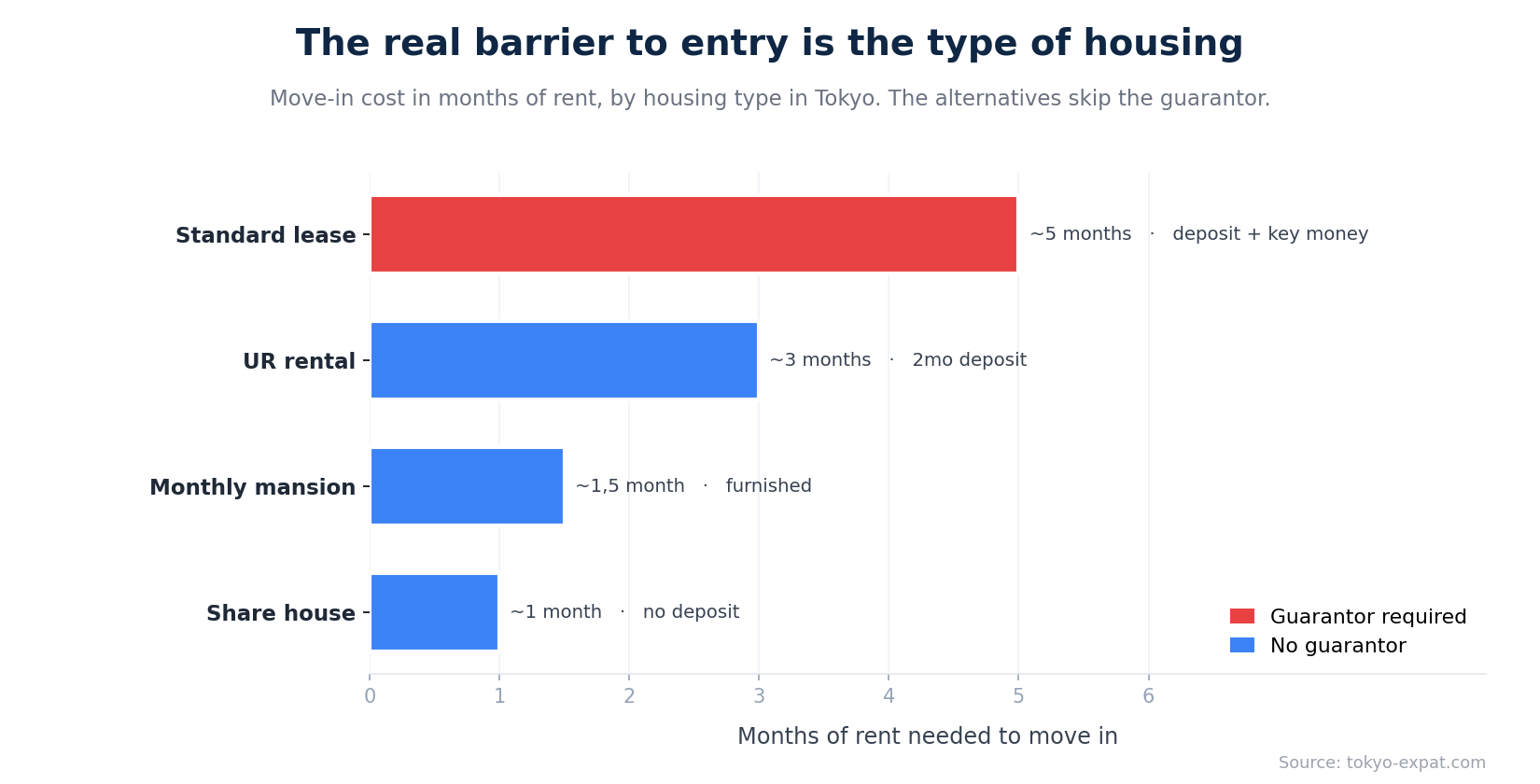
The key difference from a standard apartment: you move in with a valid visa and a security deposit. No guarantor, no key money, no 4-to-6-month upfront cost.
Get the Japan Relocation Checklist (free PDF)
90+ concrete action items to prepare your move to Japan, across 7 phases. Sent instantly.
How much does it actually cost?
Monthly rent: 45,000 to 90,000 JPY depending on room size, neighbourhood, and amenities.
Move-in costs: typically 1 month refundable security deposit plus administrative fees of 10,000 to 30,000 JPY. No reikin (key money).
What is usually included: water, electricity, gas, and internet are often included in the rent. Always confirm before signing.
Minimum stay: some operators accept stays from 1 month, others require 3 months minimum.
Total move-in budget for a Tokyo share house: 100,000 to 180,000 JPY, versus 400,000 to 600,000 JPY for a standard apartment.
Main operators in Tokyo: price comparison
| Type | Monthly rent (JPY) | Min. stay | Guarantor | Profile |
|---|---|---|---|---|
| Budget / outer wards | 40,000-65,000 | 1 month | Not required | Further from centre, best for tight budgets |
| Standard central | 50,000-85,000 | 1 month | Not required | Direct access to Yamanote or Chuo Line |
| Premium central | 55,000-100,000 | 1 month | Not required | Larger rooms, quality shared spaces |
| Mixed community | 55,000-95,000 | 1 month | Not required | Japanese and international residents together |
All expat-specialist operators accept foreign tenants without a Japanese guarantor. Utilities (water, electricity, internet) are typically included in the monthly rent.
Best neighbourhoods for share houses
Ikebukuro: highly connected (3 metro lines), international atmosphere, solid share houses at 50,000 to 70,000 JPY.
Shinjuku / Nakano: direct access to JR Chuo Line, lively neighbourhoods, abundant supply.
Shimokitazawa: village-within-the-city atmosphere, popular with young creatives. Note: less well served by transport.
Koenji / Asagaya: under the radar for foreigners, very affordable, artistic community, characterful properties.
Saitama / Northern suburbs: if your budget is tight (under 50,000 JPY), options exist 30 to 45 minutes from the centre.
House rules: what to expect
Japanese share houses have codes. Breaking them can mean a warning or eviction.
Noise: walls are thin. The unwritten rule is no audible noise from the corridor after 10pm.
Kitchen: clean immediately after use. Dishes left on the drying rack for one hour are tolerable. Overnight is not.
Guests: most share houses prohibit or strictly limit guests. Some ban all visitors in private rooms. Read the house rules before signing.
Rubbish: selective waste sorting is mandatory in Japan. Plastic, glass, paper, food waste: each category has a specific collection day. The operator explains your municipality's rules.
Shoes: always removed at the entrance (genkan). This is non-negotiable.
How to apply from abroad
The majority of share house operators accept online applications. The typical process:
- Browse available rooms on the operator's website (photos, floor plans, availability dates)
- Submit an application form: name, nationality, profession, arrival date, expected duration
- Video interview (often basic Japanese or English)
- Confirmation and security deposit transfer
Time from application to confirmation: typically 3 to 7 days.
What operators look at: financial stability (income or employer letter), expected length of stay, and compatibility with current residents.
Share house vs apartment: how to choose
A share house is the right choice if:
- You are arriving for less than 18 months
- You want to meet people and practise Japanese
- Your budget is under 80,000 JPY/month
- You do not yet have a Japanese guarantor or bank account
An apartment is preferable if:
- You plan to stay more than 2 years
- You need space (family, intensive remote work)
- Privacy is an absolute priority
What to look for when choosing an operator
Not all share house operators are equal. Before committing:
- Check online reviews (Google Maps reviews, Facebook groups like Expats in Tokyo)
- Ask how long the operator has been running the property
- Confirm what happens if a housemate is noisy or creates problems (is there an operator to escalate to?)
- Ask for the full house rules document before signing
The best operators have clear communication channels, English-speaking staff, and documented check-in procedures.
For health coverage during your share house stay, SafetyWing Nomad Insurance offers monthly insurance with no commitment. To improve your Japanese with housemates, iTalki offers private lessons with native teachers from $10/hour. (affiliate links)
See also: Gaijin House vs Share House in Tokyo: What Is the Difference?, Furnished Apartment Tokyo: 5 Best Options for Expats in 2026, Gaijin House Tokyo: Complete Guide for Foreigners (2026), Expat Apartments in Tokyo: How to Find One in 2026, Furnished Apartments in Tokyo: The Complete Guide for Foreigners (2026).
Need help finding the right share house in Tokyo for your arrival date and budget? Book a free 30-minute consultation.
Frequently Asked Questions
What is a share house in Tokyo and how does it work?+
Can foreigners live in Tokyo share houses?+
What is the difference between a gaijin house and a share house in Tokyo?+
How do I find a reliable share house in Tokyo?+
Get the Japan Relocation Checklist (free PDF)
90+ concrete action items to prepare your move to Japan, across 7 phases. Sent instantly.
Need help finding housing in Tokyo?
I help you find the right home, with no Japanese guarantor and no language barrier. Free consultation, no commitment, in English or French.
Book my free consultation