Tokyo Rental Contract: 12 Things to Check Before Signing
Before signing your Tokyo rental contract, verify these 12 essential points to avoid surprises: total move-in cost, hidden clauses, and the move-in inspection.
Signing a lease in Tokyo as a foreigner carries real risks if you can't read a contract in Japanese. The most common bad surprises, hidden fees, an aggressive restoration clause, a misunderstood notice period, can cost you hundreds of thousands of yen when you move out. This checklist covers the 12 points you must verify before signing.
Quick answer: Before signing a lease in Tokyo, verify 12 key points: real rent and fees, key money (reikin) and deposit (shikikin), agency and guarantor fees, the restoration clause, the notice period, renewal fees, and the building rules. Get any clause you do not understand translated: a bad surprise can cost hundreds of thousands of yen.
1. Total move-in costs
The first thing to calculate is the total upfront cost, not just the monthly rent. In Japan, the initial outlay typically includes:
- Shikikin (敷金): refundable security deposit, usually 1 to 2 months' rent
- Reikin (礼金): non-refundable "key money," 0 to 2 months' rent (sometimes negotiable)
- Agency fee: 1 month's rent + tax (legally capped at 1 month inclusive)
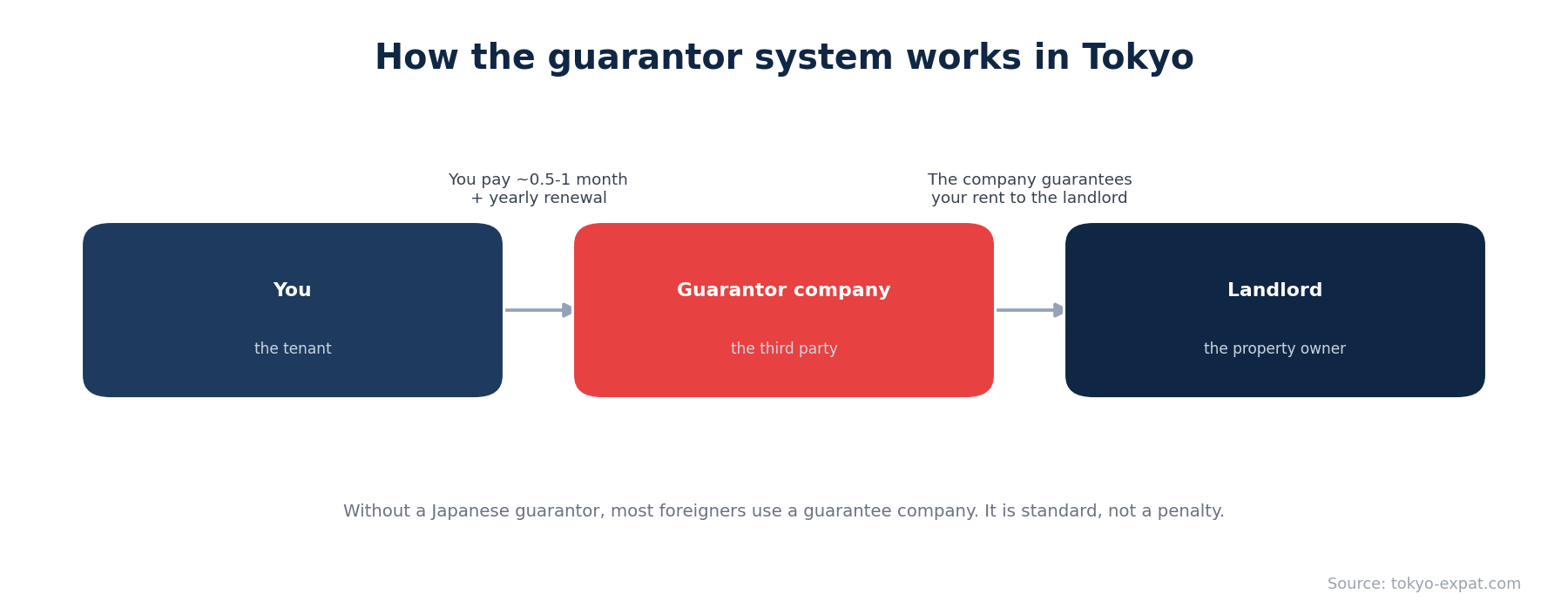
- Guarantee company fee: 0.5 to 1 month's rent upfront
- Renter's insurance: first year payable in advance
- First month's rent (sometimes prorated)
In practice: budget 4 to 6 times the monthly rent for the initial outlay. On an 80,000 JPY/month apartment, that's 320,000 to 480,000 JPY before you even get the keys.
Also read our guide on searching for an apartment in Tokyo from abroad to understand how to get ahead of the process before arriving.
2. Lease term and renewal conditions
The standard Japanese lease runs 2 years (普通借家契約 futsuu shakka keiyaku). At expiry, it can be renewed for another 2 years, sometimes with a renewal fee (koushin ryou) of 0.5 to 1 month's rent.
Verify:
- Start and end date of the lease
- Renewal fee amount
- Whether it's a fixed-term lease (定期借家契約 teiki shakka keiyaku), in this case, no automatic renewal, and the landlord may refuse to extend
Get the Japan Relocation Checklist (free PDF)
90+ concrete action items to prepare your move to Japan, across 7 phases. Sent instantly.
3. Notice period if you leave early
The standard notice period if you leave before the lease ends is 1 month, but some contracts require 2. Also check whether there's an early termination penalty (e.g., required to pay 2 months' rent if you leave within the first 6 months).
4. Restoration clause (原状回復 genjou kaifuku)
This is the clause that causes the most disputes between tenants and landlords in Japan. The legal principle is that tenants are only responsible for damage they caused, not for normal wear and tear. In practice, some landlords try to charge for work that falls under normal maintenance.
Explicitly verify:
- Who pays for the final cleaning? (often billed to the tenant even when debatable)
- Who pays for tatami or fusuma replacement due to normal wear?
- Is there a clause requiring tenants to repaint walls at their own expense?
The Ministry of Land, Infrastructure and Transport guidelines are clear: normal wear and tear is the landlord's responsibility. A lease that deviates significantly from these guidelines is open to negotiation.
5. Pet policy
The majority of apartments in Tokyo are classified as "禁止 (kinshi)" for pets. Explicitly verify whether pets are allowed, and if so, which types. If in doubt, request written confirmation, a verbal agreement provides no protection in a dispute.
6. Move-in inspection (入居前確認 nyuukyomae kakunin)
Before moving in your belongings, conduct a thorough inspection with the agency or landlord. Systematically photograph:
- All pre-existing scratches, marks, and holes on walls
- The condition of floors, kitchen, and bathroom
- All provided appliances (refrigerator, AC, etc.) and their working condition
Email the photos to the agency on the same day to create dated proof. This is your protection if the landlord tries to charge you for these damages on move-out.
7. Internet connection
Internet is not included by default in most Japanese leases. Verify:
- Is the building wired for fiber optic (hikari)?
- Do you need to contact a provider separately, and if so, what's the installation lead time? (sometimes 4 to 6 weeks)
- Is there shared Wi-Fi in the building? (common in share houses, rare in standard apartments)
8. Heating and air conditioning
Verify that each main room has a reversible air conditioner (reikon). In Japan, AC units are typically fixed to the wall and left by the previous tenant or provided by the landlord. Ask:
- Is there an AC unit in all main rooms?
- What's the condition of the filters and when was the last service?
- Is there a water heater (gas or electric) and is it functioning?
9. Parking
Parking in Tokyo is almost always paid and separate from rent. If you have a bicycle, check whether there's a bike storage area (jitenshashoki) in the building. For a car, monthly parking in central Tokyo typically runs 15,000 to 30,000 JPY.
10. Management fees (管理費 kanrihi)
In addition to rent, most apartments charge monthly management fees (kanrihi) of 3,000 to 15,000 JPY for common area maintenance, garbage, and elevator upkeep. These fees are usually listed separately in listings. Make sure they're factored into your total monthly cost calculation.
11. Apartment orientation
In Japan, exposure is critical for thermal comfort and energy costs. A south-facing apartment (南向き minamiuki) is much more desirable and expensive. A north-facing apartment will be cold in winter and prone to humidity. If you visit during the day, observe natural light at different times of day.
12. Maintenance and emergency procedure
Who do you contact in case of a breakdown (water heater, water leak, broken lock)? Is it the landlord, the agency, or a third-party management company? Is there a 24/7 emergency line?
Unresolved maintenance issues are one of the main friction points between foreign tenants and landlords. Having contacts and procedures clearly established from signing day prevents frustrating standoffs.
For more, our guide on classic traps to avoid when renting in Tokyo covers the most costly mistakes expats make.
For health coverage when signing your lease, SafetyWing Nomad Insurance offers monthly insurance with no commitment. To understand your contract in Japanese, iTalki offers lessons with native teachers from $10/hour. (affiliate links)
See also: Negotiating Rent in Tokyo: Is It Possible and How to Do It?, Tokyo Rent by Neighborhood 2026: Expat Price Guide.
About to sign a lease in Tokyo and want to make sure everything is in order? Book a consultation: we review the documents with you and identify what to negotiate.
Frequently Asked Questions
What are the main clauses to check in a Tokyo rental contract?+
What is "reikin" in a Japanese rental contract?+
How much is the security deposit (shikikin) in Tokyo?+
Can a Tokyo rental contract be terminated early?+
Get the Japan Relocation Checklist (free PDF)
90+ concrete action items to prepare your move to Japan, across 7 phases. Sent instantly.
Need help finding housing in Tokyo?
I help you find the right home, with no Japanese guarantor and no language barrier. Free consultation, no commitment, in English or French.
Book my free consultation