Guarantor for Japan Rental: Complete Guide for Foreigners
Getting a guarantor in Japan as a foreigner is often the biggest obstacle to renting. Here's everything you need to know to solve it in 2026.
The guarantor requirement is one of the most feared obstacles for foreigners looking for an apartment in Japan. In the traditional Japanese rental system, landlords require a personal guarantor, usually Japanese, who commits to paying rent on your behalf if you default. Without a local network, finding such a person is nearly impossible when you first arrive. The good news: the market has evolved, and concrete solutions exist.
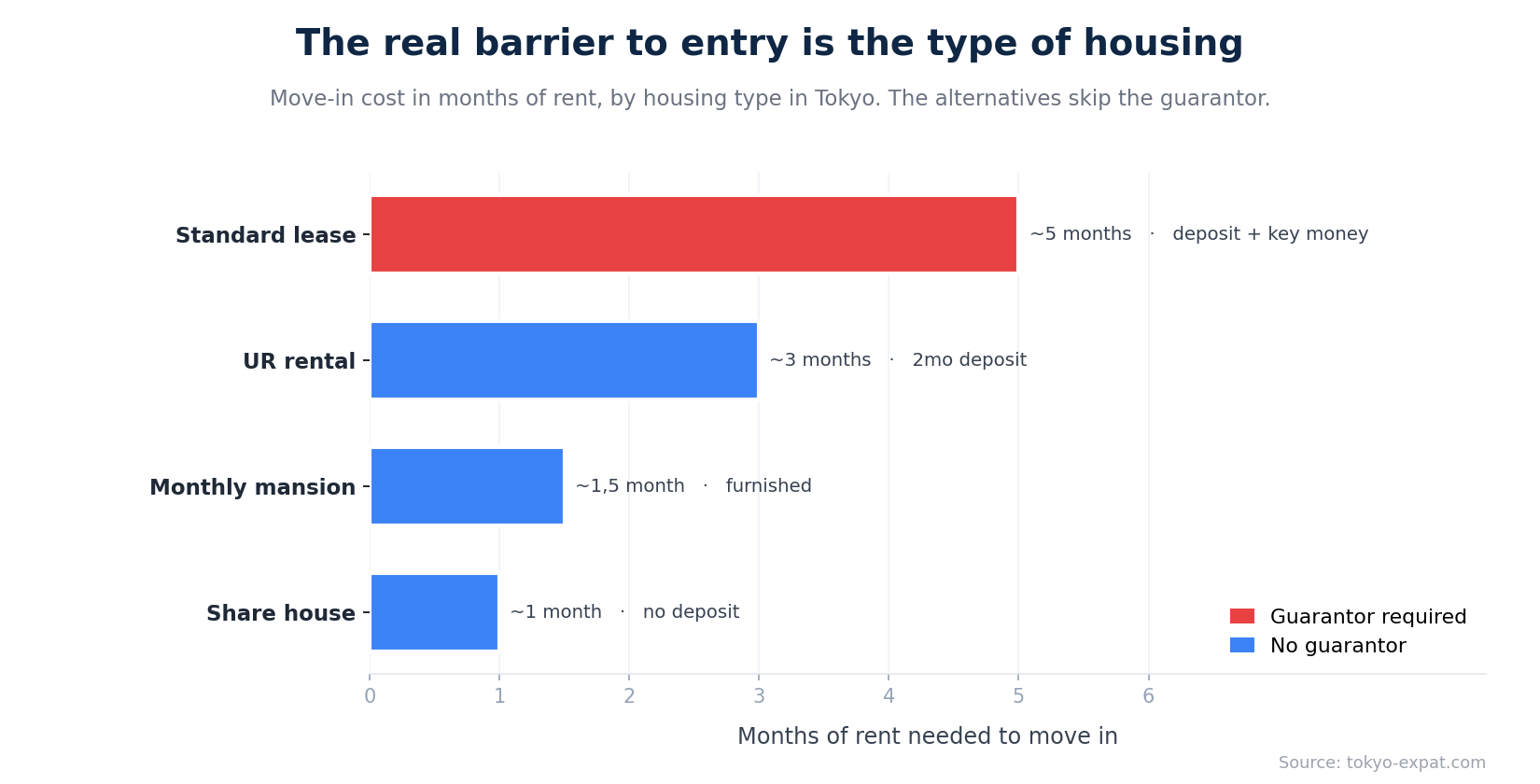
Quick answer: You do not need a Japanese personal guarantor to rent in Japan. Most foreigners use a guarantor company (hoshou-gaisha), which charges 50 to 100% of one month's rent and covers the landlord if you default. No-guarantor options (share houses, furnished or monthly mansions) skip the requirement entirely and accept a passport and visa. See our complete guide to furnished apartments in Tokyo for how these work.
From the field. Landlords are not really rejecting you as a person, they are pricing a risk they cannot read: no local credit history, unclear how long you will stay. The operators and guarantee companies that take foreigners have simply learned to read it. Give them a clean, complete file and most of the wall disappears.
The personal guarantor (保証人 hoshounin): the historical barrier
For decades, every tenant in Japan had to provide a hoshounin, literally "a person who guarantees." This guarantor had to be Japanese, resident in Japan, have sufficient income, and accept joint liability for the rent.
For an expat just arriving, it's a vicious cycle: no Japanese network means no guarantor, which means no standard apartment.
A personal guarantor may still be possible when:
- Your Japanese employer acts as guarantor (common in corporate expat transfers)
- A Japanese friend agrees to act as guarantor (rare, and a heavy commitment for them)
- Your university facilitates access to a guarantor for international students
In all other cases, the guarantee company has become the standard solution.
The guarantee company (保証会社 hoshougaisha): the modern solution
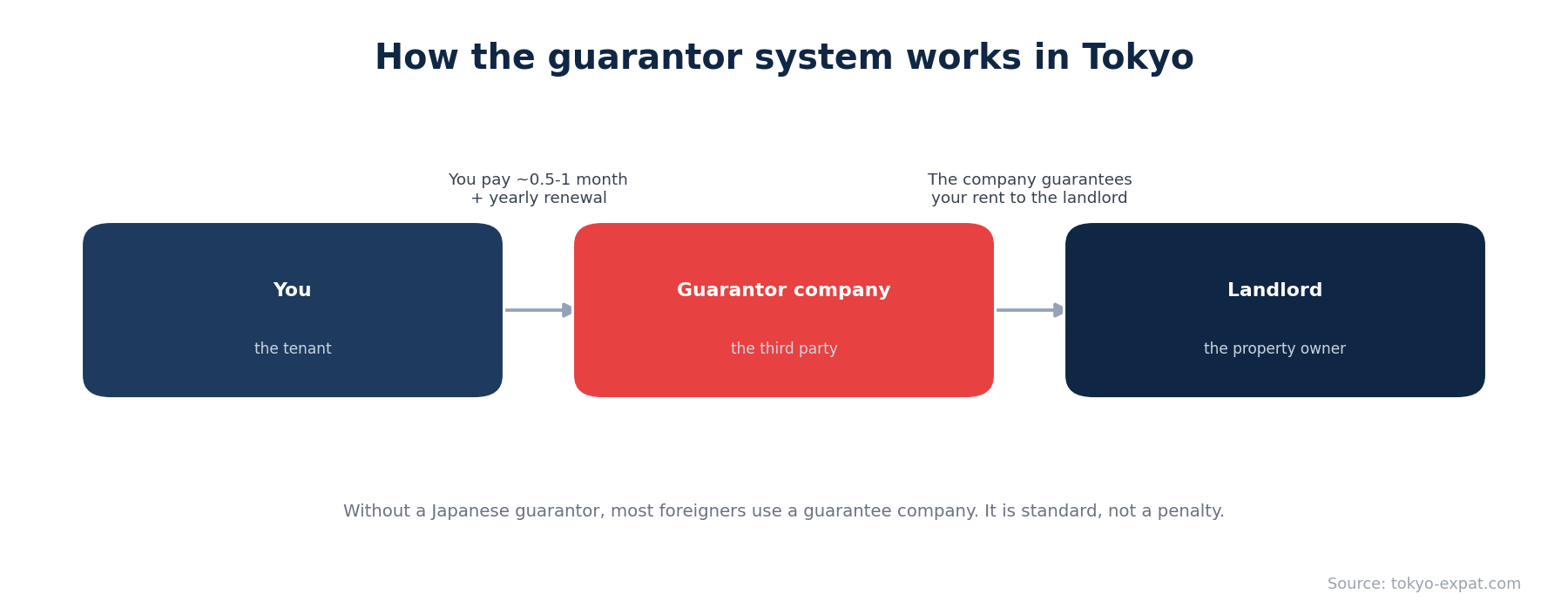
Since the 2010s, rental guarantee companies have transformed the market. Today, over 80% of landlords in Tokyo accept a hoshougaisha instead of a personal guarantor. It's now the standard even for Japanese tenants.
How it works:
The guarantee company reviews your file (visa, income, employment) and assumes the risk of non-payment for the landlord. In return, you pay:
- An entry fee: usually 0.5 to 1 month's rent
- An annual renewal fee: 10,000 to 15,000 JPY per year
Main guarantee companies accepting foreigners:
- JRFS (Japan Rental Financial Services): one of the most common, English processing available
- Cosmos Initia: often linked to ERA-affiliated agencies
- Nihon Hosho: nationwide coverage
- Rent Guarantee: simplified processing for foreign applicants
A key pitfall: some hoshougaisha verify that your residence permit covers the full lease term (typically 2 years). If your zairyu card expires before then, they may decline your application. If this applies to you, renew your residence card before signing or opt for a one-year lease.
Get the Japan Relocation Checklist (free PDF)
90+ concrete action items to prepare your move to Japan, across 7 phases. Sent instantly.
Accommodation with no guarantor required
If you can't clear the guarantor hurdle, other types of accommodation don't require one:
Share houses and gaijin houses: no guarantor, no large deposit, simplified contract. The trade-off is a private room rather than a full apartment. It's often the ideal entry point for newcomers. Our complete share house guide walks you through how to choose.
Foreigner-friendly furnished apartments: specialist operators offer furnished apartments with a simplified entry process, no hoshounin, no hoshougaisha. These are more expensive per sqm but accessible from day one. See our furnished apartment guide.
Landlords experienced with foreigners: some landlords are used to renting to foreign tenants and accept applications without a guarantor through a simplified process. Your property hunter can identify these landlords through their professional network.
Building a strong application file
Even with a hoshougaisha, your file needs to be solid. Prepare:
- Valid passport
- Zairyu card (residence card) with visible expiry date
- Employment certificate or work contract (showing salary level)
- Last 3 pay slips or bank statements
- Emergency contact details (outside Japan is usually acceptable)
If you're self-employed or recently started working, providing 3 to 6 months of bank statements with regular income significantly strengthens your application.
What a property hunter does
Navigating the guarantee system in Japanese is stressful. A local property hunter knows which hoshougaisha handle foreign profiles most smoothly, which agencies are flexible with expats, and can guide you through the full application process. They can also identify landlords open to foreign tenants from the start of the search.
To avoid the classic traps of renting in Tokyo, having someone who speaks Japanese and knows local customs often makes the difference between a signed lease in 2 weeks and an exhausting 2-month search.
For health coverage while navigating the guarantor process, SafetyWing Nomad Insurance offers monthly insurance with no commitment. To communicate with your guarantor in Japanese, iTalki offers lessons with native teachers from $10/hour. (affiliate links)
See also: Furnished Apartment Tokyo: 5 Best Options for Expats in 2026, Expat Apartments in Tokyo: How to Find One in 2026.
Looking for an apartment in Tokyo and stuck on the guarantor requirement? Book a free consultation: we'll assess your profile and identify the best-fit properties for your situation.
Frequently Asked Questions
Do foreigners need a Japanese guarantor to rent in Japan?+
What is a hoshougaisha and how does it work?+
Which guarantee companies accept foreign tenants in Japan?+
Can you rent in Tokyo without any guarantor at all?+
Get the Japan Relocation Checklist (free PDF)
90+ concrete action items to prepare your move to Japan, across 7 phases. Sent instantly.
Need help finding housing in Tokyo?
I help you find the right home, with no Japanese guarantor and no language barrier. Free consultation, no commitment, in English or French.
Book my free consultation