Moving to Tokyo in 2026: Complete Expat Checklist
Visa, housing, bank account, residence card, health insurance: the complete step-by-step checklist for relocating to Tokyo as a foreigner.
Relocating to Tokyo involves more paperwork and bureaucratic steps than most expats anticipate. This checklist covers everything from visa selection to setting up utilities, in the order you should tackle each step.
Quick answer: Moving to Tokyo runs in a clear order: confirm your visa, secure housing before you arrive, then within 14 days register your address at the ward office and collect your residence card. Next, open a bank account, enrol in national health insurance, get a SIM card, and set up utilities. Sorting the visa and housing first makes every later step easier.
Step 1: Secure the right visa (before you leave)
Your visa determines almost everything: what you can rent, where you can open a bank account, and how long you can stay.
Working visa (Engineer / Humanities / International Services): the most common for skilled workers. Requires a job offer and company sponsorship. Duration: 1 to 5 years, renewable.
Highly Skilled Professional (HSP): point-based system. If you qualify (usually 70+ points based on age, education, salary, and job type), you get priority processing and easier permanent residency later.
Spouse of Japanese national: unlimited work permission.
Working Holiday (available for French and Australian citizens aged 18 to 30): 1 year, unrestricted work up to a certain threshold.
Student visa: allows part-time work (28 hours per week). Does not allow signing most lease agreements as the primary tenant.
Key point: you cannot enter Japan on a tourist visa and then switch to a working visa from inside the country. The visa must be obtained before arrival.
Step 2: Find housing before you arrive
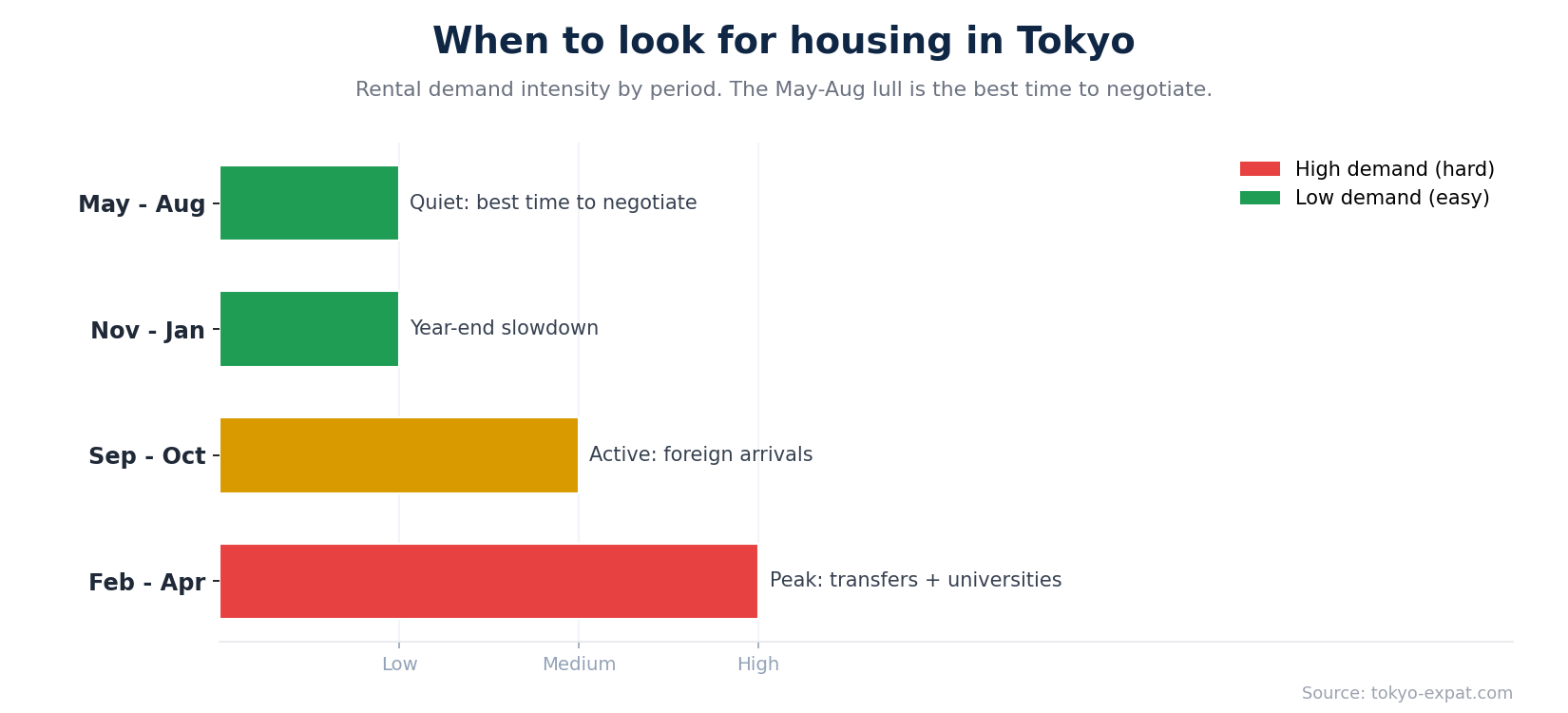
Finding housing remotely is possible, but requires a structured approach. Most foreigners make the mistake of arriving in Tokyo, staying in a hotel or Airbnb, and then spending 4 to 8 weeks searching while bleeding money on temporary accommodation.
The better sequence:
- Start your search 4 to 8 weeks before arrival
- Contact a property hunter who can visit on your behalf and send video walkthroughs
- Sign remotely and have the keys ready for your arrival day
For share houses: most operators accept remote applications and confirm within 3 to 7 days.
For apartments: some landlords accept video visits and remote signing, especially for furnished units targeting foreigners.
Get the Japan Relocation Checklist (free PDF)
90+ concrete action items to prepare your move to Japan, across 7 phases. Sent instantly.
Step 3: Register at the ward office (within 14 days of arrival)
This is the most important administrative step and the one most overlooked by new arrivals.
Within 14 days of moving into your address, you must register at your local ward office (kuyakusho) to obtain your Residence Card (Zairyu Card). The card will be stamped with your registered address.
What you need:
- Your passport with valid visa
- Your rental contract or proof of address
- The Zairyu Card issued at the airport on arrival
Your Residence Card is the foundation of your life in Japan. You need it to open a bank account, get a SIM card with a contract, and access most public services.
Step 4: Open a bank account
Opening a bank account in Japan used to require 6 months of residence. This has changed significantly.
Japan Post Bank (Yucho): the most expat-friendly. Can open with a Residence Card and passport, even recently arrived.
Sony Bank: fully online, English interface, excellent for international transfers. Requires a My Number Card (see Step 5).
Wise: not a Japanese bank, but allows you to receive and send JPY. Useful as a bridge account while waiting for a Japanese bank.
SMBC, Mizuho, MUFG (major Japanese banks): more difficult for recent arrivals. Usually require 6 months of registered residence.
Step 5: Get your My Number (Individual Number)
My Number is Japan's tax and social security identification system, equivalent to a Social Security Number or INSEE number.
You will receive a notification letter at your registered address within 2 to 3 weeks of registration. Take this letter to the ward office to receive your My Number Card (photo ID card version), which usually takes 1 to 2 months to be issued.
You need My Number for:
- Filing taxes
- Applying for national health insurance
- Opening certain bank accounts (Sony Bank, Rakuten Bank)
- Accessing government benefits
Step 6: Enrol in national health insurance
If your employer does not provide health insurance (shakai hoken), you must enrol in the national health insurance scheme (Kokumin Kenko Hoken) at your ward office.
Premium: varies by income. For a new arrival with no Japanese income history, it is usually 2,000 to 5,000 JPY per month. Coverage: 70% of medical costs.
Enrol within 14 days of losing or not having other coverage. Late enrolment means paying backdated premiums.
Step 7: Get a SIM card
Three options:
Contract SIM (docomo, SoftBank, au): requires a Residence Card and bank account. Cheapest per month (2,000 to 4,000 JPY) but involves a commitment period.
MVNO SIM (IIJmio, OCN Mobile, mineo): contract SIM on a major network, more flexible, similar prices. Good English support options.
Prepaid SIM: available immediately at the airport. More expensive per month and limited to data only (no phone number for calls).
Step 8: Get a Japanese driving licence (if needed)
If you hold an EU or Australian driving licence, you can convert it to a Japanese licence at the licensing centre without taking a practical test. Required documents include your original licence, an official translation from your country's embassy, and your Residence Card.
The process takes one day and costs approximately 3,000 to 5,000 JPY.
Note: a Japanese driving licence doubles as a government-issued photo ID for daily use.
Step 9: Set up utilities at your apartment
If you are renting an unfurnished apartment (rather than a share house where utilities are included):
Electricity: contact Tokyo Electric Power Company (TEPCO) online or by phone. Can be set up the day you move in.
Gas: a technician must come to your apartment to open the gas line. Book 1 to 2 days in advance.
Water: already connected in most apartments. Register with the local water authority within a few days.
Internet: the fastest option is a home router SIM card (available same day). Fibre broadband takes 2 to 4 weeks to install.
Step 10: Register for tax filing
If you are employed in Japan, your employer handles income tax withholding and year-end adjustments (nenmatsu chosei). You likely will not need to file separately.
If you are self-employed, freelance, or have side income: you must file a Kakuteishinkoku (individual tax return) between February 16 and March 15 each year.
Important: Japan taxes worldwide income for tax residents (those who have lived in Japan for more than 5 years in the last 10). If you are on a short-term assignment, you are taxed only on Japan-source income.
Next steps: housing and lease
Before you sign your lease, work through our complete Tokyo rental contract checklist, every clause worth reviewing, hidden fees to watch for, and what you can negotiate before committing. If you are still searching from outside Japan, our guide to finding an apartment in Tokyo from abroad covers remote search, virtual tours, and operators who accept international applications.
For health coverage during your transition, SafetyWing Nomad Insurance offers monthly insurance with no commitment. To build your Japanese before or after arrival, iTalki offers lessons with native teachers from $10/hour. (affiliate links)
See also: Best International Moving Companies to Japan (2026).
Planning your relocation to Tokyo? Book a free consultation to get housing options ready before you land.
Frequently Asked Questions
What are the most important things to do before moving to Tokyo?+
What must I do within the first two weeks of arriving in Tokyo?+
How much money do I need when first moving to Tokyo?+
Can I bring my belongings to Tokyo by international shipping?+
Get the Japan Relocation Checklist (free PDF)
90+ concrete action items to prepare your move to Japan, across 7 phases. Sent instantly.
Need help finding housing in Tokyo?
I help you find the right home, with no Japanese guarantor and no language barrier. Free consultation, no commitment, in English or French.
Book my free consultation