Student Housing Tokyo 2026: Complete Guide for International Students
How to find student housing in Tokyo: university dorms, share houses and private student residences with no Japanese guarantor, and how to apply from overseas.
Tokyo attracts thousands of international students each year for university exchanges, master's programs, or language courses. Finding the right housing in one of the world's most densely populated cities can feel overwhelming. This guide covers every realistic option available in 2026, with real budgets and the timelines you need to respect.
Quick answer: International students in Tokyo have four realistic options: university dormitories (cheapest at 30,000 to 60,000 JPY/month all-in, limited spots, apply early), share houses (40,000 to 90,000 JPY, no guarantor), private student residences (no Japanese guarantor, and short-stay plans with no deposit or key money), and independent furnished apartments (65,000 to 130,000 JPY/month depending on the neighbourhood). Most accept applications from abroad, and applying before you land is easier than applying once you are already in Japan.
University dormitories (学生寮 gakusei ryou)
This is the least expensive option, and the most competitive. Japanese universities offer internal or partner dormitories for their international students.
Advantages:
- Competitive pricing: 30,000 to 60,000 JPY per month all-inclusive (room, utilities, internet)
- Often located near campus
- Immediate social network with other international and Japanese students
- Process largely managed by the university
Disadvantages:
- Limited spots and highly competitive, not guaranteed even after university acceptance
- Strict house rules (curfews, visitor policies, kitchen hours)
- Maximum stay often limited to one year
How to apply: applications go through the international office (kokusai kouryuu) of your Japanese university. Submit it at the same time as your admission application, 4 to 6 months before arrival. Competition is intense at top Tokyo universities (Todai, Waseda, Keio, TUJ, Sophia).
Share houses for students
If university housing is unavailable or doesn't suit your needs, share houses are the most popular option among international students in Tokyo.
Typical prices:
- Private room in a standard share house: 40,000 to 65,000 JPY per month
- Room in a design/premium share house: 70,000 to 90,000 JPY per month
- Utilities and internet generally included
What to compare between operators:
- Proximity to your school (direct access without transfers)
- Mix of international and local residents in the house
- Minimum stay duration (1 month, 3 months, or a semester depending on the operator)
- English interface for booking and communication
Minimum stay: typically 1 to 3 months depending on the operator, practical for a semester abroad or a full academic year.
Our complete share house guide for Tokyo helps you understand what to check before booking.
Get the Japan Relocation Checklist (free PDF)
90+ concrete action items to prepare your move to Japan, across 7 phases. Sent instantly.
Independent furnished apartments
For students who prefer living alone or with a partner, furnished apartments in Tokyo offer genuine independence at a higher cost.
Budget to plan for:
- Furnished studio in a student neighborhood (Bunkyo, Koenji, Nakano): 65,000 to 90,000 JPY per month excluding utilities
- Furnished studio in central Tokyo (Shinjuku, Shibuya): 90,000 to 130,000 JPY per month
- Move-in costs (no reikin): typically 1 to 2 months security deposit + 0.5 month guarantee fee
Without a Japanese guarantor, a foreigner-friendly furnished apartment is often the best path: the manager understands international student profiles and can process your file even without a Japanese credit history.
Private student residences (学生マンション)
Between the university dormitory and the open rental market sits a category most guides skip: student residences run by private operators rather than by your university. They deserve attention because they solve the two problems that block international students hardest, the guarantor and the fact that you are still abroad at the moment you need to sign.
Who can apply. These are open to enrolled students of universities, junior colleges, vocational schools and Japanese language schools. You do not need to attend one of the operator's partner schools, which is the assumption that makes most students abandon the option before checking.
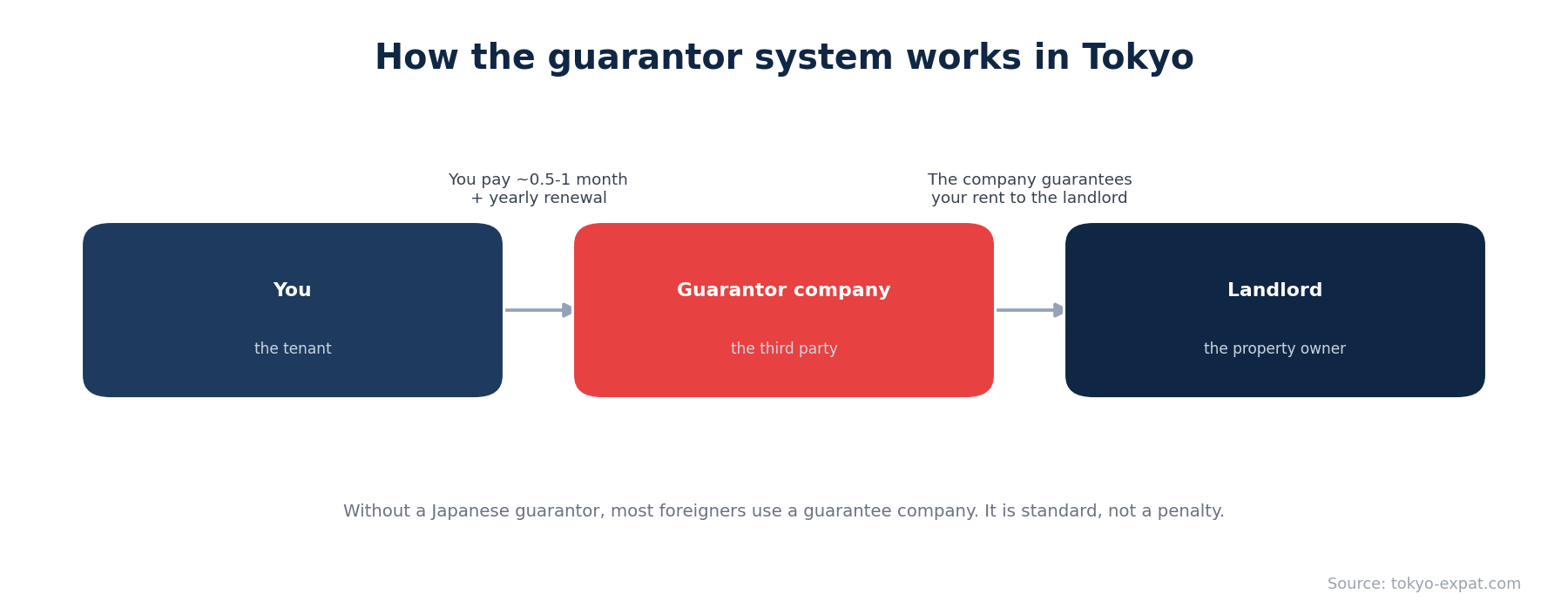
No Japanese guarantor. A rent guarantee company stands in for the personal guarantor, and international students can subscribe to it. It is the same mechanism described in our guide to the Japanese guarantor system, except that here it is built into the product instead of being negotiated case by case.
The timing rule almost nobody tells you. Whether you need a Japanese emergency contact depends on where you are when you apply:
- Applying from abroad, before you land: no Japanese emergency contact is required to sign. You provide it after you move in.
- Applying once you already live in Japan: the emergency contact is required with your application.
That is worth reading twice, because it inverts the usual instinct. It is easier to secure this housing before you arrive than after. If you are still in your home country, that is an argument for starting now rather than waiting until you land to "look at places properly".
What an overseas application needs. A Certificate of Eligibility is not required by the housing operator. A typical file is your own basic details, your school acceptance letter, your passport, and basic details for one parent. That is far lighter than a standard lease file.
Contract length, and the March cycle. Student residence contracts usually run one or two years and follow the Japanese academic year, so the term ends in March. For a language student staying six to twelve months, the normal route is to sign a one-year contract and terminate early, which is permitted. Read the early termination clause before signing: some buildings charge a penalty of around 30,000 JPY.
Under six months: short-stay plans. Several operators run a monthly plan for short stays, from one month upward, and the economics are unusual: no security deposit, no key money and no agency fee. Rent typically bundles electricity, water, gas, fire insurance, Wi-Fi and a bedding set. Budget a one-off cleaning fee of around 22,000 JPY, plus two optional extras where offered: a meal plan around 33,000 JPY per month, and a furniture and appliance pack around 5,500 JPY per month.
The trade-offs are real. One person per room, you must be currently enrolled, and because there is no deposit the non-smoking clauses are strict. Rooms on these plans also close as soon as they fill, so they reward applying early rather than comparing for weeks.
Set against a share house, you get your own room and a predictable all-in monthly figure. Set against a private lease, you skip the move-in costs that normally swallow three to five months of rent before you have even received the keys.
The four options compared
| Option | Monthly rent | Move-in costs | Japanese guarantor |
|---|---|---|---|
| University dormitory | 30,000 - 60,000 JPY all-in | Variable, set by the university | No |
| Share house | 40,000 - 90,000 JPY | 1 to 2 months (deposit only) | No |
| Private student residence | Operator-dependent, utilities and Wi-Fi included | Short-stay plan: no deposit, no key money, no agency fee (cleaning ~22,000 JPY) | No, guarantee company |
| Furnished apartment | 65,000 - 130,000 JPY | 1 to 2 months deposit + 0.5 month guarantee fee | No |
| Standard apartment | 80,000 - 130,000 JPY | 4 to 6 months | Yes |
On a typical student housing budget of 60,000 to 90,000 JPY per month, share houses and private student residences are the two formats that work without compromising on location.
Best student neighborhoods in Tokyo
The right neighborhood depends on your university, but here are the most popular areas for students:
Bunkyo-ku (文京区): the quintessential university district. Home to the University of Tokyo (Todai), Tokyo University of Science, and others. Quiet, well-connected, many student housing options. The Hongo and Nezu pocket is the most sought after.
Shinjuku-ku (新宿区): central, multiple subway lines, close to Waseda University and Sophia University's Yotsuya campus. More lively, slightly pricier. Around Waseda and Takadanobaba there is a deep supply of student share houses at 55,000 to 75,000 JPY.
Koenji / Nakano (高円寺・中野): popular among students for good value for money. Well-served by the Chuo Line. Alternative, artistic atmosphere.
Ikebukuro (Toshima-ku): well connected to several universities, large share house supply at 50,000 to 80,000 JPY.
Avoid for a student budget: Minato, Shibuya, and Roppongi. Rent is 30 to 50% higher for similar living quality.
The rule that matters more than the ward name: live within 30 minutes of your campus. Tokyo's trains are reliable, but a 45-minute-plus commute twice a day wears you down over a full semester.
Financial aid available for international students
International students in Japan can access several funding sources:
JASSO (Japan Student Services Organization): monthly scholarship of 48,000 to 117,000 JPY depending on criteria. Apply through your Japanese university after arrival.
MEXT Scholarships: Japanese government scholarship program, very competitive, covers tuition, housing, and a monthly stipend. Apply before arrival through the Japanese embassy in your country.
Japanese Embassy Scholarships: program for short stays (language study, semester abroad). Check with the Japanese embassy or consulate in your home country.
Institutional support: your home university may have cooperation agreements that include housing assistance. Check with your international office.
Timeline and deadlines to respect
Time management is critical for student housing in Tokyo:
- 6 months out: apply for university dormitory through your Japanese university
- 3 months out: if dorm not confirmed, start searching for a share house or furnished apartment
- 1 to 2 months out: book your housing, prepare required documents (admission letter, proof of student visa)
- On arrival: activate contract, collect keys, register at the local city hall (required within 14 days of arrival)
⚠️ That schedule is the university dormitory one. The private market moves faster. According to the student housing operators I deal with, rooms for an April entry start opening up from September and October of the previous year, and by late January there is almost nothing left. If you are aiming for April, the "1 to 2 months out" line above will get you there after everyone else. The full calendar for both intakes is in our article on when to book your student room in Tokyo.
Starting early matters. The best rooms in popular share houses go weeks in advance, especially for September and April intakes.
The most common student mistakes
Waiting for the visa before starting the search. This is the most expensive mistake and the most common one. Most operators accept a file before the visa is issued, and private student residences do not even require a Japanese emergency contact as long as you apply from abroad. Waiting costs you two months on an already tight calendar.
Ignoring the early termination clause. If you go home before the contract ends, you may owe one to two months in penalties, and some residences charge a flat fee of around 30,000 JPY. Read that clause before signing, and ask for a 30-day notice exit where the operator allows it.
Underestimating the transport budget. A monthly train pass between your housing and your campus often costs 10,000 to 20,000 JPY. Add it to the rent before concluding that a distant neighbourhood is "cheaper": the gap frequently disappears entirely.
Not confirming the operator accepts student visas. Some share houses only take work visas, and some residences require current enrolment. Confirm this before sending your file rather than after.
How our service helps students
We hold a direct line to housing operators who take international students: share houses open to student visas, private student residences with no Japanese guarantor, and furnished apartments on flexible contracts, within a sensible commute of the major Tokyo campuses.
A 30-minute consultation is enough to identify what is genuinely available on your arrival date, within your budget and near your university. Availability is confirmed with the operator before anything is sent to you.
For health coverage during your studies in Japan, SafetyWing Nomad Insurance offers monthly insurance with no commitment, popular among students before enrolling in national insurance. To improve your Japanese, iTalki offers lessons with native teachers from $10/hour. (affiliate links)
See also: Student Housing in Tokyo for October Intake: Share House vs University Dorm, Share House in Tokyo: the complete guide.
Preparing a study stay in Tokyo and need housing sorted before you arrive? Get in touch for a free consultation, we'll help you find the right option for your budget and visa type.
Frequently Asked Questions
What are the housing options for international students in Tokyo?+
Can international students rent a private apartment in Tokyo?+
How far in advance should international students look for housing in Tokyo?+
What is the cheapest housing option for students in Tokyo?+
Get the Japan Relocation Checklist (free PDF)
90+ concrete action items to prepare your move to Japan, across 7 phases. Sent instantly.
Need help finding housing in Tokyo?
I help you find the right home, with no Japanese guarantor and no language barrier. Free consultation, no commitment, in English or French.
Book my free consultation