Why Japanese Landlords Reject Foreign Tenants (Insider View)
A Tokyo rental insider explains the real reasons Japanese landlords reject foreign tenants, and the concrete steps that get your application approved.
If you are a foreigner hunting for an apartment in Tokyo, you will probably hear "no" before you hear "yes", and often you will not be told why. I operate rentals here myself, so I deal with guarantor companies and see tenant screening from the landlord's side, and the reasons behind those rejections are rarely what newcomers assume. Here is the honest picture from the inside, and what actually turns a "no" into a "yes".
Quick answer: Japanese landlords reject foreign tenants mostly out of perceived risk, not prejudice: no guarantor, communication worries, income that looks unstable, or unfamiliar paperwork. The fixes are concrete: use a guarantor company, present clean proof of income, target foreigner-friendly listings, and have your application presented properly in Japanese. Do that and most rejections disappear.
It is about risk, not dislike
Most rejections are not personal. A landlord renting to a tenant they cannot easily communicate with, who has no local track record and no Japanese guarantor, sees risk. Their worst case is unpaid rent and a complicated eviction. Almost every "no" flows from that single fear.
The number one reason I actually see
The single most common reason is not your income or your visa: it is the combination of no guarantor and communication risk. A landlord who cannot picture how they would resolve a problem with a foreign tenant, and who has no guarantor backing the rent, will default to "no". Fix those two and most of the resistance disappears.
Beyond that, a few factors come up again and again:
- No guarantor. Most landlords require one, and a newly arrived foreigner rarely has a Japanese person to fill the role.
- Income that looks unstable. Freelancers, new hires and students raise more questions than a salaried employee with payslips.
- Communication risk. If the agency fears they cannot resolve an issue with the tenant, they hesitate.
- A visa or contract that looks short or uncertain.
If your application keeps getting turned down, our guide on what to do when your rental application is rejected walks through each fix.
Get the Japan Relocation Checklist (free PDF)
90+ concrete action items to prepare your move to Japan, across 7 phases. Sent instantly.
What surprises most foreigners
It is often not the landlord alone deciding. The management company and the guarantor company screen you too, and any one of them can decline, usually without giving a reason. And some buildings simply have a blanket no-foreigner policy that has nothing to do with how strong your application is. A "no" is often about which door you knocked on, not about you. This is why working from the right listings matters as much as your profile, something we cover in our guide to finding an apartment in Tokyo as a foreigner.
The pattern that gets people approved
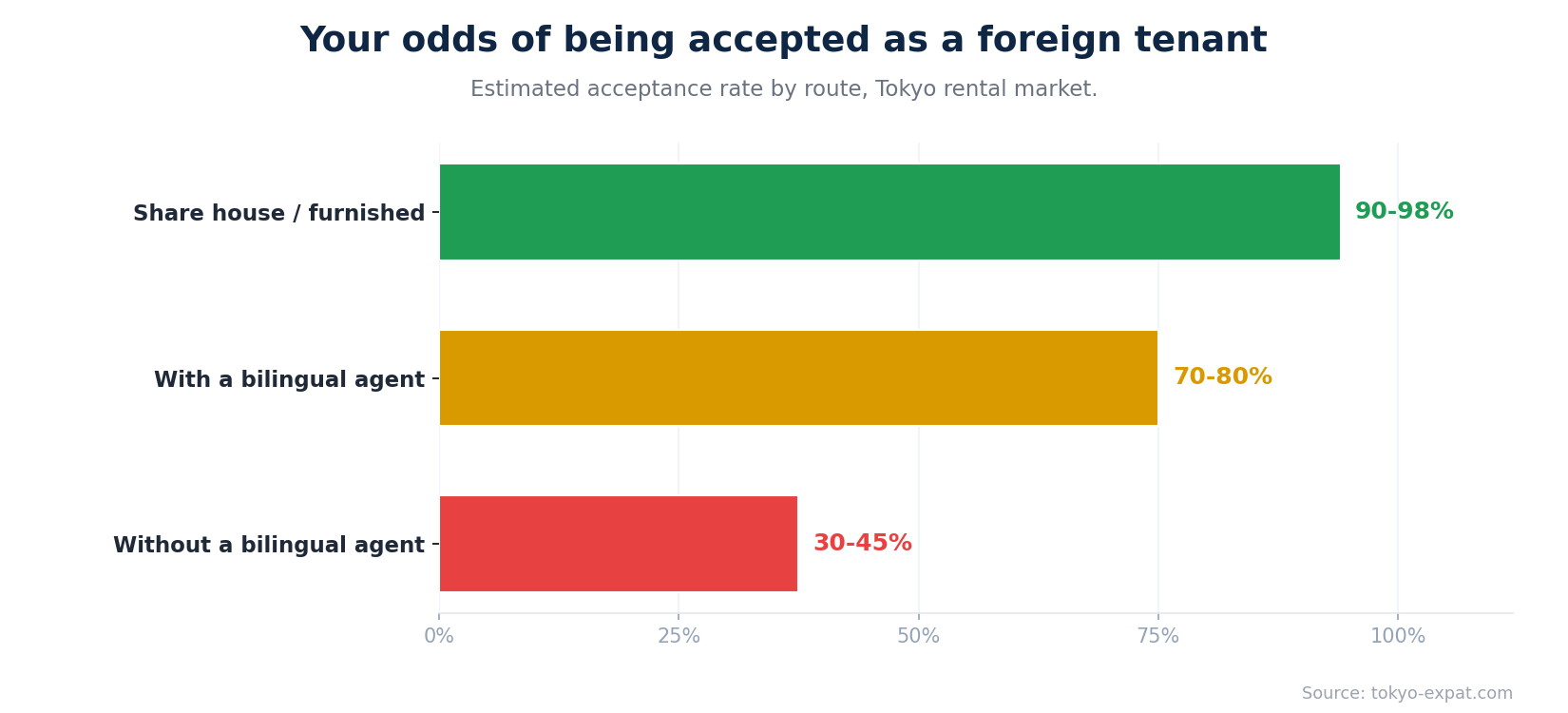
Here is something I see constantly: the same applicant, same income, same job, gets rejected on one property and approved on another within the same week. The tenant did not change. What changed was whether a guarantor company was attached, whether the paperwork was complete, and whether the application was presented properly in Japanese to a landlord open to foreign tenants in the first place. The profile did not improve; the framing did.
If you want to skip the guarantor problem entirely at first, furnished apartments without a Japanese guarantor and share houses are the fastest way in.
How to get approved
- Use a guarantor company. This removes the single biggest objection. It is normal and expected today.
- Present income cleanly. Tax documents, an employment letter, or bank statements reassure far more than words.
- Target foreigner-friendly listings. Do not waste energy on landlords who opt out.
- Have your application presented in Japanese. This is where many quiet "no" answers become "yes".
The Japanese rental market is not hostile, but it is opaque, and the decisions happen on a side of the table most foreigners never see. Knowing how landlords actually think is half the battle. If you would rather have someone who works inside the market handle it and get your application approved, you can book a free 30-minute call.
Frequently Asked Questions
Why do Japanese landlords reject foreign tenants?+
Is it legal for landlords in Japan to refuse foreigners?+
How can a foreigner get a rental application approved in Tokyo?+
Do you need a guarantor to rent an apartment in Tokyo?+
Get the Japan Relocation Checklist (free PDF)
90+ concrete action items to prepare your move to Japan, across 7 phases. Sent instantly.
Need help finding housing in Tokyo?
I help you find the right home, with no Japanese guarantor and no language barrier. Free consultation, no commitment, in English or French.
Book my free consultation